Zhou’s box turtle is a species of Asian box turtle belonging to the genus Cuora.
- Cuora zhoui – Zhao, Zhou & Ye, 1990
Very little is known about this species and most of what we know comes from the keeping and breeding of the species in captivity. There are currently two different lines of Zhou’s box turtle being bred in captivity. One in the United States and one in Europe (Mainly Germany)
This species is known under three different synonyms:
- Cuora zhoui – Zhao, Zhou & Ye, 1990
- Cuora pallidicephala – McCord & Iverson, 1991
- Pyxiclemmys zhoui – Vetter, 2006
Table of Contents
Cuora zhoui Distribution
Very little is known about the distribution of this species since all known specimens can be traced back to food markets in the Guangxi and Yunnan Providences. No one knows for sure exactly where this species originates from but an educated guess based on the information known would suggest that the species has a limited distribution within the two previously mentioned provinces. Although it is possible that other unknown populations still exist and are waiting to be discovered.
Because no new specimens have been found in these food markets for several years some scientists now believe that the species might be extinct in the wild and that the fate of the species is dependent on the specimens that have made it into captivity. The majority of all known Zhou box turtles are kept in private collections.
Zhou’s Box Turtle Habitat
Since Zhou’s box turtle is only known from food markets it is hard to say anything for certain in regards to their natural habitat. The species is however believed to originate in remote hill streams in the Guangxi and Yunnan Providences. This seems to be supported by the fact that they do well in temperatures between 65 – 85 °F / 18 -30°C.
Observing the species in captivity has shown that it is a shy species that spend much of its time hidden underwater. It is safe to assume that they display similar behaviour in the wild. This behaviour might explain why this species is so seldom seen. Even if there is a limited population left in their natural habitat their shyness might prevent them from being seen and caught.
Body
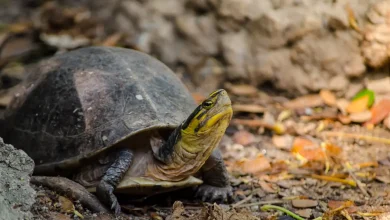
Zhou’s box turtle is adapted to life in and around the water. The carapace is high and dome-shaped. The colouration varies between different individuals as well as during the life span of a turtle. The base color is usually gray or brown with different levels of yellow and orange patterning. The colours are usually brighter in younger specimens.
They grow to be about 7 inches long. Males and females seem to reach the same size.
What does Cuora zhoui eat?
C. zhoui is an omnivorous species that feeds during both day and night. They will eat anything from fruit and plants to live fish, earthworms, snails and small crayfish. They spend most of their time foraging looking for food in the water but they will also look for food on land. When disturbed they often retreat with food found on land to the water to eat in peace.
How old can a Zhou’s box turtle get?
This species was only discovered in 1990 so it is not possible to say how old they get. It is however safe to assume that they like other box turtles can live for a long time provided that they do not attract any illness or suffer from an accident.
Keeping Zhou’s box turtle as pets
There is only a very limited amount of Zhou’s box turtle available. The offspring of these turtles are mainly placed with other experienced breeders and institutions to help preserve the species. If you are anything but an experienced turtle keeper who has kept and bred several different Asian box turtles such as Cuora pani and C. galbinifrons you should not even try to get a hold of this species.
The low numbers of turtles that exist are better of in experienced hands until their number can be increased through careful genetically monitored breeding.
Below I will provide some basic information about keeping and caring for Zhou’s box turtle. I do however strongly recommend talking to an expert such as Elmar Meier (the first man to breed this species) before setting up a habitat for this species.
Housing a Zhou’s box turtle
Zhou’s box turtle is a largely aquatic turtle and a well-made aquatic area is a requirement for successfully keeping the species. The species is shy and it is therefore important to provide it with good shelter both on land and in water. The aquatic area should contain logs or other ornaments under which the turtles can hide. If they are not provided with enough hiding places they will get stressed which can have negative effects on the health of the turtles. The species will go up on land to fetch food and will occasionally bask. They usually only bask when they think no one is around so do not be surprised if you never see your turtles bask. This does not mean that you can remove their basking spot. The land area should contain plants and ground cover.
Zhou’s box turtle prefers lower temperatures and if you live in a hot area it can be good to install a cooler as well as a heater to prevent the land temperature from going over 85°F/ 30°C in the summer. The water temperature is during the summer best kept at around 80F°/27°C. The winter temperature is best kept above 65°F/18°C. Kept the same air and water temperature during the winter. They can share a pen with other Asian box turtles with similar temperature requirements.
Feeding a Zhou’s box turtle
This species should be fed a high-protein diet with some fruit and vegetables for variation. They can be fed a base diet of floating fish pellets with a high protein content (30%+). They should however also be feed a number of other items such as earthworms, snails, live fish and shrimp to provide them with all the nutrients they need. It is recommended to supplement their diet with fruits or vegetables once or twice a week. They will accept several different fruits but an easy-to-use alternative is sliced bananas. They can be fed both in the water and on land. If your turtles seem unwilling to accept food on land you should feed them in the water. Given a little time and patience, you should be able to train them to accept food on land by slowly moving the food a little bit closer to / further up on land every day.
References
- McCord,W.P. & Iverson,J.B. 1991. A new box turtle of the genus Cuora (Testudines: Emydidae) with taxonomic notes and a key to the species. Herpetologica 47 (4): 407-420
- He, Jing; Zhou, Ting; Rao, Ding Qi; Zhang, Ya Ping. 2007. Molecular identification and phylogenetic position of Cuora yunnanensis. Chinese Science Bulletin 52 (23): 3305-3309.
- Parham, James Ford ; W. Brian Simison; Kenneth H. Kozak; Chris R. Feldman and Haitao Shi. 2001. New Chinese turtles: endangered or invalid? A reassessment of two species using mitochondrial DNA, allozyme electrophoresis and known-locality specimens. Animal Conservation 4: 357–367 [erratum in Animal Conservation 5:86].
- Zhao,E. Zhou,T. & Ye,P. 1990. A new Chinese box turtle (Testudinata: Emydidae) – Cuora zhoui. In: E. Zhao (ed) From water onto Land. Chinese Soc. Study Amphib. Rept. Beijing: 213-216